

Golden Ratio Face Calculator
Your golden ratio face score, from one photo. Five exact measurements, your percentile among 66 real faces, and which feature of yours comes out strongest.
Your photo never leaves your device · No signup · Free
Process
Three steps to a golden ratio face score.
- 01
Upload
A front-facing photo, any phone camera.

- 02
Landmarks
478 points placed on the face automatically, in your browser.
- 03
Report
Your five measurements, and where you sit.
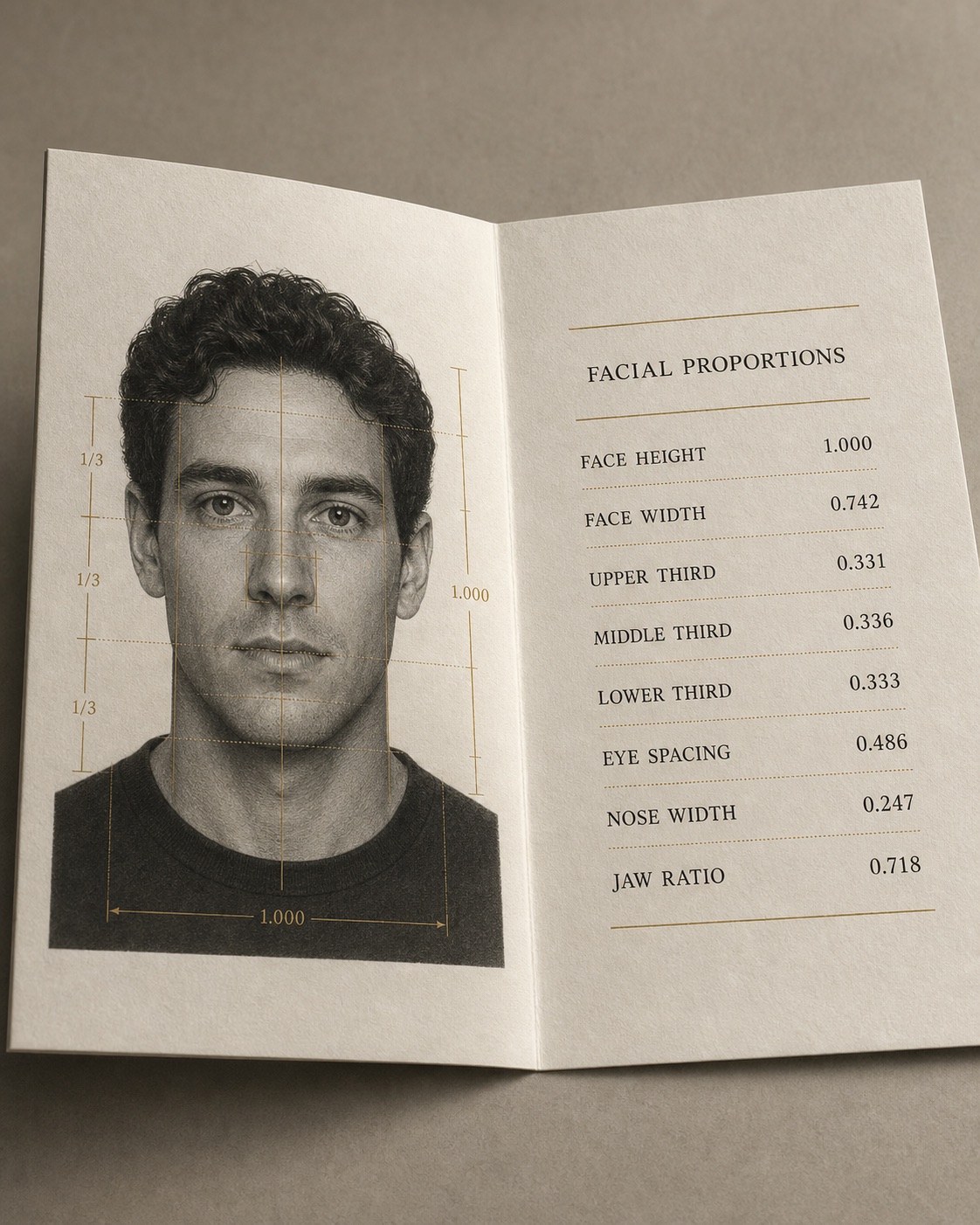
The measurement
Specimen
Report
21stpercentile
Memorable
About 79% of faces sit closer to the golden ratio, and about 21% sit further away.
About 30 out of 100 faces land here
Faces like yours are the ones people remember.
Your strongest feature
Lower face90% balanced
Every face has one measurement that comes out best. This one is yours.
Share my result
Symmetry
Both halves, rebuilt on their own.
The outer frames rebuild the whole face from one side alone. Wherever they part from the middle frame is where the two halves disagree. None of this enters the score: the golden ratio only measures proportion, and says nothing about symmetry.
Your photo was measured, then dropped. The numbers are yours.
Your link carries five numbers and nothing else. No photo, no name.
The engine
478 landmarks.
Five ratios.
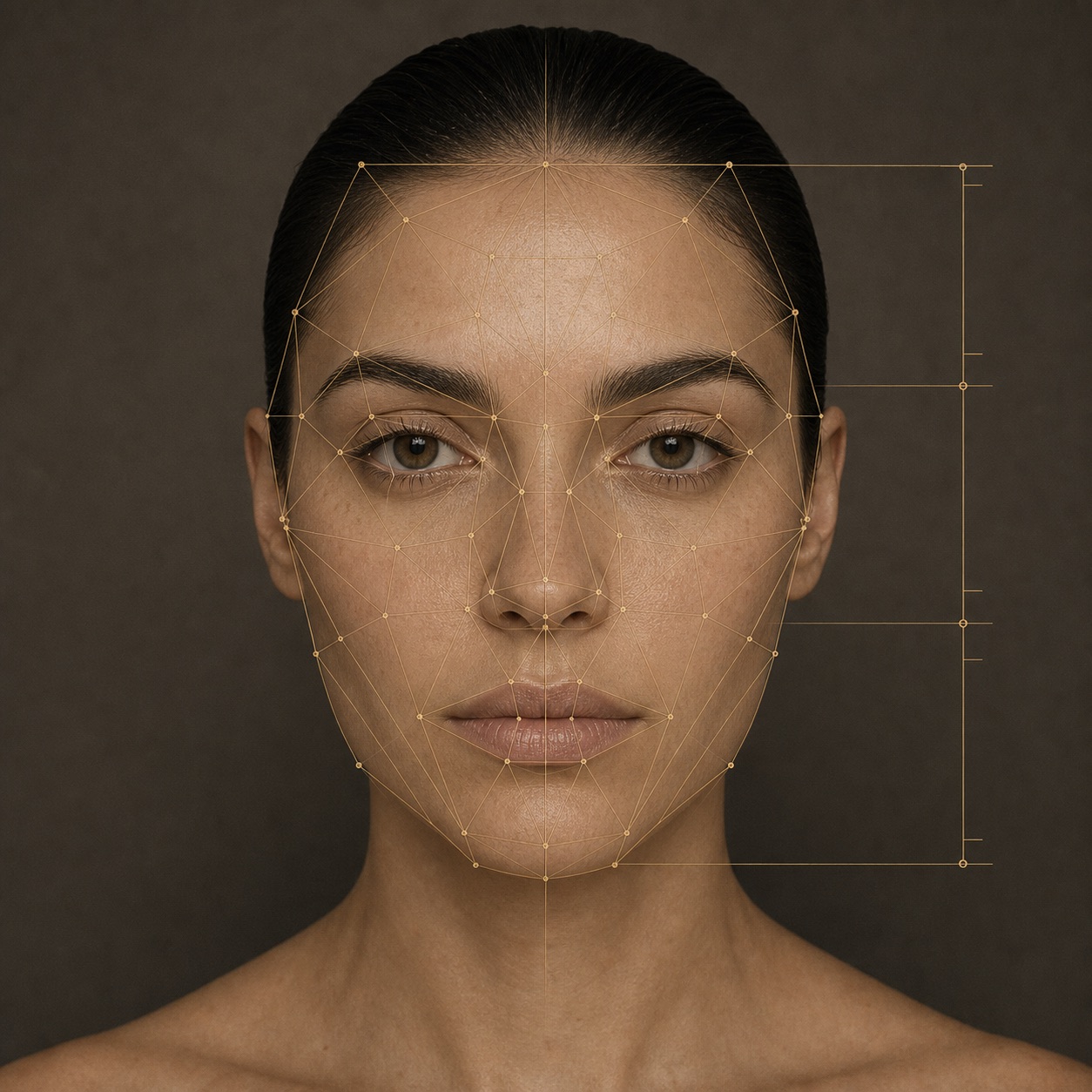
A face mesh runs inside this page and places 478 points on your photo. The measurement frame is then rebuilt from your own eye corners and chin, so a turned or tipped head is corrected before any ratio is computed.
Each measurement is compared to 1.618 and reported as a gap, with the direction it leans. Your golden ratio face score is not the average of the five — it is your place in line: the share of faces sitting further off than yours, calibrated on 66 front-facing photographs measured by this same engine. The arithmetic is printed next to every number.
How the ratios are definedWhat a golden ratio face score means.
A golden ratio face score here is a percentile, not a grade out of 100. It says how far your five measurements sit from 1.618 compared with everyone else, and nothing more than that. A golden ratio face at the 70th percentile simply has about 30% of faces sitting closer to 1.618. Every band below carries a name, a plain reading, and a share of the population, so the digit is never the whole answer.
| Percentile | Tier | What it means | How common |
|---|---|---|---|
| 99 to 100 | Rare harmony | All five measurements land almost exactly where the golden ratio predicts | Under 1% |
| 85 to 98 | Striking balance | Most measurements sit close to the golden ratio | Top 15% |
| 65 to 84 | Naturally balanced | Good balance, with small differences | Top 35% |
| 30 to 64 | Softly balanced | Where most faces land | The middle 35% |
| Below 30 | Memorable | Proportions that stand apart — which is what makes a face easy to remember | About 30% |
Shares come from the measured spread of each ratio across 66 real faces, not from a survey of golden ratio face scores. No score here ranks one person against another, and there is no leaderboard.
The five ratios, in plain terms.
Each one is a length divided by another length, compared to the golden ratio, then scored by how far off it lands. These five are the whole of a golden ratio face measurement here: five numbers, one arithmetic rule, no hidden weighting.
- 01
Face height / width
Brow line down to the chin, against the span between the outer eye corners.
- 02
Lower face
Jaw width against the drop from the nose base to the chin.
- 03
Eye span to nose
Span between the outer eye corners, against nose height.
- 04
Eye width
Distance between the eye centres against the gap between the inner corners.
- 05
Eye to mouth
Eye line down to the mouth, against lower lip to chin.
The golden ratio has nothing to say about symmetry, skin, expression, bone definition, or how a face reads in motion. Those carry most of the weight in how a face is actually perceived, and none of them are measured here.
Golden ratio face questions people actually ask.
What is a good golden ratio face score?
The score is a place in line, so it reads directly: 85 and above is the top 15%, 65 and above the top 35%, and most faces land between 30 and 85. Below 30 the table calls Memorable, which is about 30% of faces. Read the band, not the digit.
How do I calculate my golden ratio face score by hand?
Measure five lengths on a front-facing photo, divide each pair, and compare the result to 1.618. The ratios section on this page gives the exact endpoints for all five. If you would rather not hold a ruler to a screen, the calculator does the same arithmetic from the landmarks it reads off your photo, and you can also type your own five numbers into it.
Why do some beautiful people score lower than expected?
The golden ratio measures proportion only. It has no access to symmetry, skin quality, expression, bone definition, or the way a face reads in motion, and those carry most of the weight in how attractive a face actually looks. A face can sit far from 1.618 and still be striking. The number tells you about geometry, not about beauty.
Is a golden ratio face the same as an attractive face?
No, and the research is fairly clear about it. Studies on facial proportion point mostly at averageness and symmetry as predictors of perceived attractiveness, and the golden ratio correlates only loosely with either. A golden ratio face score is a distance measurement against one number, which is a much narrower claim than beauty.
Should I worry if my score is not high?
No. The score is a distance measurement, not a verdict. Every band has a name, a share of the population, and a plain reading of what it does and does not cover.
What counts as the most golden ratio face?
A face whose five measured ratios all land on 1.618 at once, which is vanishingly rare — far rarer than a high score, because the average face does not sit on 1.618 in the first place. That is why this tool tells you where you sit instead of crowning anyone, and why there is no leaderboard here.
My score changed with a different photo. Why?
Head rotation is handled for you — the measurement frame is rebuilt from your own eye corners and chin, so a turned or tipped head is corrected before any ratio is computed. What does move the reading is landmark placement: resolution, focus, lighting, and filters all nudge the points, and a small nudge moves you several points when your score sits in the crowded middle of the range. The band you land in is the stable part; the exact digit is not.
Why is my golden ratio face score different on another website?
Because most sites score the raw distance from 1.618 and stop there, which bunches nearly everyone into the 80s and 90s. This one turns that distance into a place among real faces, using how much each ratio actually varies between people, measured on 66 front-facing photographs through this same engine, so the reference and your reading come from one pipeline. Different definitions of the five ratios also change the reading, so two golden ratio face calculators can disagree while both doing their arithmetic correctly.
Does this work for all ethnicities and ages?
The five ratios are pure geometry, so the arithmetic is identical for every face. The set of faces we compare you against is the part that varies: average proportions differ across populations and shift with age, so a position drawn from one set will not describe every face equally well. We do not detect or record ethnicity.
Where does my photo go?
Nowhere. Measurement runs in this browser. The photo is never sent to a server, never stored, and is gone when you close the tab.
Can I run a golden ratio face test without uploading a photo?
Yes, twice over. Nothing is ever uploaded even when you do pick a photo, because the measurement engine runs inside this page. And if you would rather not use a photo at all, the calculator accepts five typed ratios and produces the same report from them.
How accurate is a golden ratio face calculator?
The arithmetic is exact and the same photo always gives the same answer, but the inputs carry real uncertainty: small shifts in where the landmarks land, plus the cost of reading a three-dimensional face from a flat image. Scores in the middle of the range move the most, because that is where faces are most crowded together, so a little measurement noise shifts the number a lot. Read a golden ratio face score as the band it falls in rather than as an exact figure.
Do I need to pay or create an account?
No, to both. There is nothing to sign up for and nothing to buy, because the measurement runs on your own device rather than on a server we have to pay for. That also means there is no account holding a history of your results — close the tab and the only thing left is the share link, if you chose to copy one.
Can I change my facial proportions?
Proportions are bone and soft tissue geometry, so they are largely settled after growth. This site measures them and stops there. It gives no cosmetic or medical advice and links to no clinics.
What photo works best?
Front-facing, even lighting, hair clear of the brows and jaw, at least 60 pixels between the pupils, no beauty filters. Glasses glare and hair across the jawline are the two things that move the numbers most.
What exactly do you measure?
Five ratios, all read from the same set of facial landmarks: face height against eye span, jaw width against the drop from nose base to chin, eye span against nose height, eye spacing against the inner-corner gap, and the eye line to the mouth against lower lip to chin. Each is compared to 1.618, then scored against how much that particular ratio varies between people.
Handling
Your photo is measured, then dropped.
The whole golden ratio face measurement runs in this browser. Nothing is uploaded, nothing is stored, nothing is trained on, and a shared link carries five numbers rather than a face.
Where 1.618 comes from.
1.618
Cut a line so that the whole length divided by the longer part equals the longer part divided by the shorter part. That single condition has one positive solution, 1.6180339887, and mathematicians write it as φ. It shows up in pentagons, in the Fibonacci sequence as the ratio between consecutive terms, and in the proportions of a rectangle you can cut a square from and be left with a smaller copy of the original.
Renaissance artists studied it, and the idea that faces near this number read as balanced has been repeated ever since. The evidence for that link is thinner than the popular claim suggests. Studies on facial proportion and perceived attractiveness point mostly at averageness and symmetry, and the golden ratio is only loosely correlated with either.
So this site does the honest version of the idea. A golden ratio face reading here measures the distance between your proportions and 1.618 precisely, shows the arithmetic, and stops short of telling you what that distance means about your face.

Start with one photo.
Get your golden ratio face score and see the proportions that make your face uniquely yours.
Analyze a photoSee a sample report